Managed Cybersecurity Services in Dallas | 4.9-Rated MSSP on Google & G2
Managed cybersecurity services in Dallas for companies that have outgrown "our IT provider handles security." ITECS puts a named local team on watch around the clock, runs the controls your insurer, auditors, and customers ask about, and reports to you in plain English — working alongside your IT lead or current IT provider, not around them.
- Co-managed with your IT lead
- Response targets in writing
- Analysts on watch 24/7
At a glance
ITECS by the numbers
The numbers behind the rating, with public sources where they exist.
- Since 2002
- Protecting Dallas–Fort Worth companies through every wave of threats since 2002
- Founded in February 2002.
- ITECS company release
- 7,000+
- Laptops, servers, and devices under active protection
- 24/7
- Watched around the clock — attackers don't keep office hours, and neither does our monitoring
- 95%
- Client retention. Companies that start with ITECS stay with ITECS.
- ITECS-reported figure, published in December 2025.
- Read the source
01Start from your situation
Find the security path that fits your current risk
Most companies arrive here because something forced the question: an insurer, an auditor, a customer, a close call, or growth. Pick the situation that sounds like yours.
- 01
“Someone is asking hard questions.”
Your insurer sent a renewal questionnaire, an auditor wants evidence, or a key customer wants your security controls in writing. Start with an assessment that answers those questions honestly.
Start with an assessment - 02
“You have IT. Nobody owns security.”
Your IT lead or provider keeps things running well. But no one's job is to hunt for attackers at 2 a.m. or to keep policies and evidence current. Start with a program plan that fits alongside what you already have.
Plan the security program - 03
“Something happened — or nearly did.”
A close call, a phishing email that got clicks, a peer company in the news. Find out what's actually exposed, validated and prioritized, before deciding what to fix first.
Review known weaknesses - Now
“You're dealing with an incident right now.”
Skip the reading. Call (214) 444-7884 or go straight to breach response.
Go to breach response
02Core offerings
Dallas Cybersecurity Services: Everything the Program Needs, One Accountable Team
Security fails at the seams between vendors. ITECS runs the layers as one program — endpoint protection, email defense, firewall management, identity monitoring, testing, training, and compliance evidence — with around-the-clock analysts (Sophos MDR) and Dallas–Fort Worth engineers who come on site when it matters.
Why it matters
Most breaches start with one unprotected device or one convincing email. For a company doing regulated work, the cost isn't only the outage — it's the notification letters, the insurer's questions, and the customer who asks what happened.
How we solve it
One team owns detection, response, email defense, firewall management, and the compliance paperwork. Analysts watch around the clock; you get a monthly readout you can hand to your leadership, your insurer, or your auditor.
What it costs
Pricing is scoped by the number of devices and users protected and the controls you select. Before you sign, the proposal itemizes what's included, how often we review with you, and what's excluded — so there are no surprises in month three.
How the layers fit
One program, watched as a whole
Testing
Around-the-clock watch
01Analysts and ITECS engineers across every layer below
- 01
Network edge
Managed next-generation firewall
- 01
Devices
Laptops and servers, with detection and response
- 01
Identity and email
Microsoft 365 sign-ins and inbox filtering
- 03
People
Training and realistic phishing tests
Your data and operations
Compliance evidence
- Testing02
- Compliance evidence04
Detect and respond
Devices, inboxes, sign-ins, and the network edge, watched and defended.
Managed Endpoint Detection & Response (MDR/EDR)
Protection on every laptop and server, plus analysts who investigate and stop attacks around the clock. Threat hunting and automated response neutralize attacks before they can impact your business.
Email Security & Microsoft 365 ITDR
ITECS pairs Check Point email filtering for phishing, malware, and business email compromise with Petra Security ITDR: detecting stolen logins in Microsoft 365, investigating across the tenant, and coordinating containment.
Managed Firewall Services
Our managed next-generation firewall service provides 24/7 monitoring, configuration management, and threat intelligence to stop attacks before they can penetrate your network perimeter.
Find weaknesses first
Scans and controlled tests that show what an attacker could reach.
Vulnerability Assessment Services
Identify known weaknesses across external, internal, cloud, identity, and endpoint environments, validate the findings, and prioritize remediation without exploitation by default.
Penetration Testing
Our expert penetration testing services identify and exploit vulnerabilities in your systems before attackers do, providing actionable remediation guidance to strengthen your security posture.
Plan and prepare your people
A roadmap for leadership and practice for everyone with an inbox.
Cybersecurity Consulting & Risk Assessment
Our expert consultants provide strategic guidance on security architecture, risk assessment, compliance management, and security roadmap development tailored to your specific business requirements.
Security Awareness Training
Short, regular training and realistic phishing tests so your people recognize the email that would have worked.
Prove it to auditors and insurers
Controls mapped to your framework, with evidence ready before anyone asks.
CMMC Compliance
Prepare for CMMC assessments with policy hardening, evidence collection, and security controls aligned to DFARS requirements.
HIPAA Compliance
Protect patient data (ePHI) with the controls the HIPAA Security Rule requires, plus risk analysis and audit-ready documentation for healthcare organizations.
03When something is caught
How 24/7 monitoring and response works
Every alert follows the same path, and you can see who does what at each step. Your IT team is kept in the loop instead of being surprised, and leadership gets an account written for people who don't read logs.

01
Detect
Watch devices, sign-ins, and inboxes for attacker behavior
02
Investigate
Confirm what is real and set aside the noise
Add context on what is normal for you
03
Contain
Minutes, once confirmed
Cut the affected machine off from the network
Coordinate the next moves
Hears what was isolated, and why
04
Recover
Clean up, restore, and close the gap
Works alongside on users and timing
05
Report
Document cause, scope, and every change
Receives the same write-up
Gets a plain-English summary
Security that protects.Not just compliance theater.
Real cybersecurity is layered defense, continuous monitoring, tested response plans, and a team that treats your risk like its own.
A good security program is quiet. Someone is always watching, real threats are acted on while they are still small, and you hear about it in plain English.
What this includes
Continuous threat monitoring
Laptops, servers, and network devices are monitored in real time, with alerting and triage already in place.
Managed detection and response
Sophos MDR pairs automation with analyst-led threat hunting, so anomalies get investigated instead of ignored.
Incident containment in minutes
Once a compromise is confirmed, the affected device is cut off from the rest of your network before the damage spreads.
24/7
Analyst coverage
Minutes
To isolate a confirmed threat
Monthly
Plain-English readouts
Co-managed
Alongside your IT team
04Working together
The ITECS Advantage: Dallas MSSP Partnership
One accountable team
One number to call, one team that owns detection, response, and the paperwork. No vendor pointing at another vendor.
Works with your IT lead, not around them
Co-managed by design. Your IT staff or current IT provider keeps their role; ITECS adds the security layer and the 24/7 watch nobody on a small team can staff.
Reports you can hand to your insurer, your board, or your auditor
Monthly readouts in plain English, evidence organized for HIPAA, PCI DSS, CMMC, and SOC 2 readiness, and a Technical Account Manager who walks you through it.
Co-managed model
Who owns what
Your IT lead or provider
- Day-to-day IT
- Keeps their current role
- Briefed on findings and changes
Shared
- One written playbook
- Priorities set with leadership
- Changes timed around operations
ITECS
- Security monitoring and response
- Compliance evidence
- Monthly readouts
The operating rhythm
What you'll see over a year
Continuous
24/7 monitoring and response
Monthly
Plain-English readout
Quarterly
Tabletop exercise
Scheduled
Strategy session with your Technical Account Manager
05Addressing modern cybersecurity challenges
Cybersecurity Challenges Dallas Businesses Face Today
The five problems we hear about most, and what ITECS does about each one.
01
Ransomware and Zero-Day Threats in Dallas
Pain point
Your antivirus catches known malware, but ransomware crews now sign in with stolen passwords and move quietly before they strike.
ITECS solution
Analysts investigate suspicious behavior on every device as it happens and pull an infected machine off the network before ransomware can spread.
02
Dallas Security Talent Gaps and MSSP Coverage
Pain point
You can't justify a full-time security team, and the MSSPs you've talked to felt like a help-desk queue, not a partner.
ITECS solution
A named Technical Account Manager leads scheduled strategy sessions with you, so you're never a ticket number.
03
Phishing and Social Engineering Defense
Pain point
Your staff are one believable invoice or password-reset email away from handing an attacker the keys.
ITECS solution
Email filtering screens messages before they reach inboxes, and phishing tests show who needs coaching before an attacker finds out.
04
HIPAA, PCI DSS, and CMMC Compliance
Pain point
Your auditor, insurer, or prime contractor wants proof of your controls, and building it falls to someone who already has a full-time job.
ITECS solution
ITECS ties each control to the framework you answer to and keeps the evidence current, so it is ready when the request arrives.
05
Dallas Incident Response and Containment
Pain point
You don't have a written plan for the day something goes wrong, so every decision during an incident gets made from scratch.
ITECS solution
ITECS writes your incident response plan with you and runs it when an incident happens: contain, recover, and report.
06Local accountability
Why Dallas Companies Keep ITECS as Their MSSP
You'll know the people watching your network. ITECS is headquartered in Dallas, has served North Texas companies since 2002, and keeps 95% of its clients — because a security program only works when the same accountable team owns identity, endpoints, email, firewalls, monitoring, and response, and answers for the result.
Security also has to let the business run. ITECS maps controls to HIPAA, PCI DSS, and CMMC, documents gaps and who owns them, and gives you reporting that stands up in front of an insurer or auditor. Customers and their qualified advisors remain responsible for compliance conclusions.
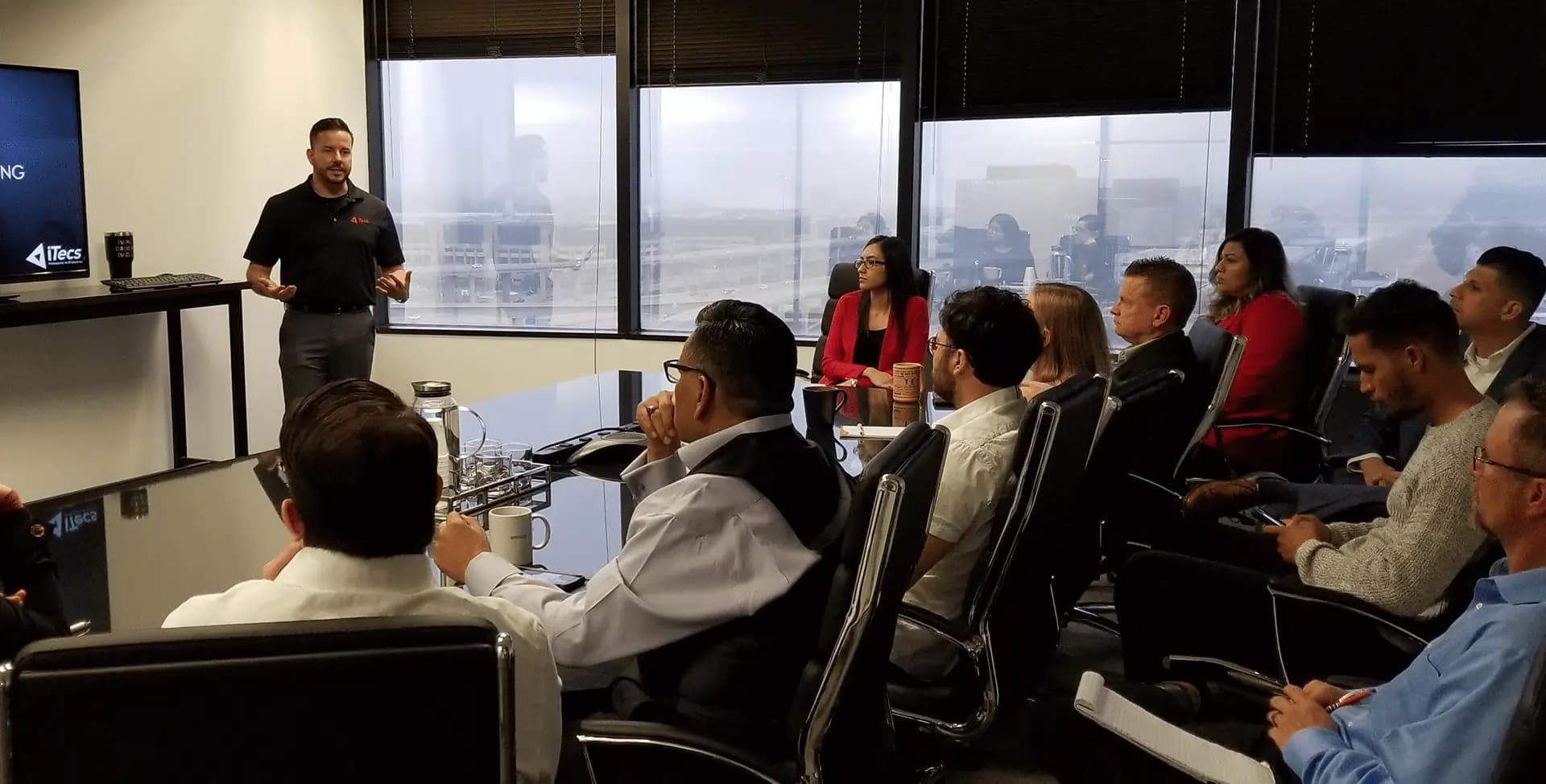
On site across the Metroplex
Remote monitoring covers every hour. When the fix needs hands on hardware, ITECS engineers drive to you from headquarters on Preston Road.
- Addison
- Allen
- Carrollton
- Dallas
- Fort Worth
- Frisco
- Irving
- McKinney
- Plano
- Richardson
07Trusted expertise
Certified Managed Security Experts in Dallas-Fort Worth

Sophos Gold Partner in Dallas
Our Sophos partnership backs managed detection and response (MDR): analysts watching for attackers and stopping them, around the clock, with direct escalation paths and tested playbooks.
Check Point CCSE-Certified Security Engineers
Our Certified Security Expert (CCSE) engineers design and maintain your firewalls and network segmentation, so a problem on one machine doesn't become a problem everywhere.
Trusted Across Dallas-Fort Worth
Medical practices, manufacturers, law firms, financial advisors, and defense suppliers across Dallas-Fort Worth rely on ITECS to watch their systems and stand behind the answers they give insurers, auditors, and customers.
Current Partner Credentials
MSSP Advanced

Gold Partner
Microsoft
Solutions Partner – Security

VCSP Silver

Technology Partner
08Proof
Recent security work

Senior Flexonics Pathway
CMMC readiness · Defense manufacturing
CMMC Level 2 Readiness for Defense Manufacturing
How ITECS supported CMMC Level 2 readiness for a defense and aerospace manufacturer, from security plan and policy documentation to firewalls across three facilities and managed security monitoring.
Read the case study
Confidential financial services firm
Isolated cloud security · Financial services
Financial Services Compliance: Isolated Cloud Architecture
An isolated managed cloud environment for a firm facing investor security requirements, with network segmentation, multifactor authentication, controlled communications, and endpoint controls kept separate from the rest of the company.
Read the white paper09Free assessment
Zero-Cost Network Security Assessment & Risk Analysis
Free Cybersecurity Assessment for Dallas Businesses
- 1
What happens. A security consultant walks your environment with you or your IT lead — devices, identities, email, backups, network, and the policies behind them — against the same NIST CSF 2.0 and CIS Controls v8 checkpoints insurers and auditors draw from. No installs required to start.
- 2
What you get. A plain-English readout of where you stand, the three to five things to fix first, and what each would take. It's yours whether or not you hire us.
- 3
What you don't get. A scare deck. If your current provider is doing well, the report will say so.

ITECS
Security readout
Where you stand
- Devices
- Identities
- Backups
- Network
- Policies
Fix first
Three to five priorities, each with effort and owner
10Frameworks
Security Program Reference Points
- NIST CSF
- Cybersecurity Framework 2.0 aligned
- Since 2002
- serving Dallas organizations
- CIS v8
- CIS Controls v8 benchmarked
- SOC 2
- SOC 2, PCI DSS & HIPAA readiness
See how ITECS applies the NIST and CIS frameworks in the documented cybersecurity assessment methodology.
11A plain-English primer
What does a managed cybersecurity partner actually do for a Dallas business?
A managed cybersecurity partner — often called a managed security service provider, or MSSP — takes on the security work your IT team doesn't have hours for: watching for attackers, escalating and containing incidents, keeping compliance documentation current, and telling leadership what to fix next. ITECS delivers that watch with Sophos MDR, backed by local engineers who handle escalation and on-site work across Dallas–Fort Worth.
Each layer covers a different way in: managed firewall protection guards the network edge, endpoint detection and response covers every device, email security blocks phishing campaigns, vulnerability assessments find and rank known weaknesses, and penetration testing uses controlled exploitation to confirm which attack paths are real. The same program supports HIPAA, CMMC, PCI DSS, and SOC 2 readiness.
The result is a security program you can review, explain, and defend, backed by a Dallas MSP that has protected local companies since 2002.
12Questions
Dallas Cybersecurity Services FAQ
Answers to the most common questions Dallas leaders ask about managed cybersecurity, compliance, and MSSP coverage.
Have a question that isn't here?
A security engineer can answer it directly.
Endpoint protection with managed detection and response, email security, managed firewalls, vulnerability assessments, penetration testing, security consulting, and staff training, plus compliance support for HIPAA, PCI DSS, and CMMC. Monitoring runs around the clock, and ITECS engineers handle escalation and response.
Most IT providers are good at keeping systems running; very few staff analysts to watch for attackers around the clock or maintain the evidence insurers and auditors ask for. ITECS is built to work alongside your IT lead or provider as the security layer, so nothing you have today has to change on day one.
No. Co-managed is the normal arrangement: your team keeps day-to-day IT, ITECS owns security monitoring, response, and compliance evidence, and both sides work from the same playbook. If you'd rather have ITECS run all of it, that's available too.
Yes. ITECS implements the security controls each framework calls for, closes the gaps it finds, and maintains the documentation, audit trails, and reports an assessor will ask to see. You and your qualified advisors make the compliance determination; we supply the controls and the evidence behind it.
Yes. Insurers now ask for specific controls — multifactor authentication, endpoint detection and response, tested backups, security training, and documented incident response. ITECS implements the controls and keeps the evidence, so questionnaire answers change from 'no' to 'yes, and here's the proof.' We'll also review your renewal questionnaire with you.
Most security vendors sell a product and leave you to run it; ITECS runs the whole program as one accountable team, from monitoring and response to email, firewalls, and compliance evidence. You get a dedicated Technical Account Manager, scheduled strategy sessions, and executive-level reporting in plain English. ITECS has served Dallas–Fort Worth since 2002, keeps 95% of its clients, and is headquartered in Dallas.
Continuous detection and analyst investigation across your laptops, servers, identities, and email, escalation to ITECS engineers who know your environment, coordinated containment, and a written record of what happened and what changed. Coverage details are itemized in your proposal.
Analysts monitor around the clock, and a compromised device can be isolated at the network level within minutes of confirmation. Response targets are written into every ITECS agreement — ask for a sample agreement before you sign, and compare it with what you have now.
Yes. Medical practices need HIPAA controls and the records to prove them. Manufacturers and defense suppliers need CMMC readiness and protection for designs and production systems. Law firms need client confidentiality, and financial firms need PCI DSS controls and records a regulator will accept. ITECS builds the program around the rules and risks of your industry.
The return shows up as fewer surprises: consistent controls, clear ownership when something goes wrong, better answers for your insurer, and less load on your IT team. We model the business case from your risk profile, your insurance requirements, and what it would cost to staff the same coverage yourself, not from a universal savings percentage.
Protect Your Dallas Business with Managed Cybersecurity
Start with a conversation, not a sales pitch. You'll leave knowing where you stand, what to fix first, and what it would take — whether or not you work with ITECS.