
Achieve CMMC Compliance with Dallas's Leading RPO Partner
ITECS is your trusted Registered Provider Organization for CMMC certification. We've helped 150+ DoD contractors achieve compliance with a 98% first-attempt success rate. From Level 1 basic hygiene to Level 3 advanced protection, we streamline your path to certification.
CMMC Compliance Dallas
CMMC roadmaps that stand up to DFARS and C3PAO scrutiny
CMMC 2.0 readiness is more than “having security tools.” Defense Industrial Base (DIB) contractors need evidence: scoping, controls, documentation, and repeatable processes tied to NIST SP 800-171 and DFARS requirements. We help you build an audit-ready program that contracting officers and primes can trust.
Executive-ready scorecards
Milestones and risk prioritized for leadership, primes, and contracting workflows.
Evidence-first security
Controls implemented with audit artifacts, logs, and repeatable operating procedures.
Assessment rehearsal
Mock interviews and evidence walkthroughs so your team is ready for assessor questions.
Supporting DFW defense contractors near the Richardson Telecom Corridor, Las Colinas, AllianceTexas, Arlington, and across Dallas, Plano, and Fort Worth.
Your readiness snapshot
A practical, step-by-step path from scoping to evidence—designed to reduce rework and accelerate audit readiness.
Scope the environment
Identify FCI vs CUI, define boundaries, and inventory systems in scope.
Implement core controls
MFA, endpoint hardening, encryption, vulnerability management, and backups.
Document and evidence
SSP, POA&M, policies, incident response plans, and evidence library mapping.
Validate and prepare
SPRS scoring support, mock assessments, and final readiness reviews for C3PAO.
Best next step
Start with a readiness assessment and scoping workshop to confirm your target level and the fastest path to evidence.
Request a CMMC readiness assessmentBoundary-Aware CMMC Architecture
Your MSP’s tools can make or break your CMMC assessment
The CMMC Assessment Boundary follows where CUI flows — not org charts or network diagrams. Every system, person, and third-party tool that CUI touches or could touch is inside the boundary. The DoD’s official scoping guide defines five asset categories that determine what falls in or out.
The “ability to access” standard
CMMC doesn’t require a tool to actually access CUI — only that it has the ability to. If a tool has technical capability to reach CUI, even if policies say it shouldn’t, the tool is in scope for your assessment.
Interactive CMMC boundary scoping diagram — the red zone shows how an MSP’s tools can break your boundary
The Five CMMC Scoping Categories
Per the DoD CIO CMMC Level 2 Scoping Guide — every asset in your environment falls into one of these categories
CUI Assets
Systems that directly process, store, or transmit Controlled Unclassified Information.
Examples
File servers, email (GCC High), VDI, collaboration platforms
Assessment
All 110 practices + 320 objectives
Security Protection Assets
Tools providing security functions to the CUI environment — even if they never touch CUI directly.
Examples
Firewalls, SIEM, EDR/XDR, MFA services, VPN gateways
Assessment
Practices relevant to their security function
Contractor Risk Managed
Assets that could technically access CUI but are governed by policy and controls not to.
Examples
RMM tools, ticketing systems, line-of-business apps
Assessment
Limited — but weak documentation invites reclassification
Specialized Assets
OT, IoT, and government-furnished equipment that are difficult to assess against full controls.
Examples
Industrial sensors, GFE, test lab systems, ICS
Assessment
Documented in SSP with segregation requirements
Out of Scope
Completely separated from CUI — physically or logically. You must prove the separation.
Examples
Guest WiFi, marketing systems, personal devices
Assessment
Not assessed — but assessors can challenge exclusion
How your MSP’s tools silently expand your CMMC boundary
Most scope expansion is accidental. An MSP adds a monitoring tool, a SOC analyst downloads a suspicious file for analysis, a backup job copies CUI to an uncertified cloud — each silently extends your boundary without anyone updating the SSP or data flow diagrams.
MDR / SOC
SOC analysts can download files from CUI endpoints — pulling the entire vendor cloud and analyst workstations into your assessment boundary.
RMM Agents
Persistent agents on CUI systems create a direct pipeline from your environment to the MSP's uncertified cloud platform.
Backup Solutions
Copying CUI to MSP-controlled storage makes that storage, facility, and all supporting infrastructure in-scope.
Ticketing / PSA
CUI details logged in tickets or PSA tools pull those platforms — and the vendor behind them — into your boundary.
Why this matters for your assessment
If a vendor tool in your environment can reach CUI and isn’t FedRAMP Moderate authorized, the entire arrangement fails CMMC compliance. The vendor becomes an External Service Provider (ESP) that must demonstrate NIST 800-171 compliance — and if they can’t, it counts against your assessment, not theirs.
Boundary-aware architecture that protects your certification
ITECS designs your environment so the CUI boundary is as small as possible. We keep our own tools and infrastructure outside your boundary wherever feasible — reducing compliance cost, attack surface, and assessment complexity.
Vet every tool for boundary impact before deployment
Use FedRAMP-compliant platforms for CUI workloads
Deploy client-owned infrastructure to avoid MSP overlap
Architect CUI enclaves to minimize what's in scope
Maintain a clear Shared Responsibility Matrix for all 110 controls
Issue client-owned secure devices to MSP staff when CUI access is needed
Real example: The MDR boundary trap
A common MSP deploys an MDR solution where the SOC can download files from endpoints. If those endpoints contain CUI:
- 1.The MDR agent becomes a Security Protection Asset
- 2.The vendor’s SOC, cloud, and data pipeline are now in scope
- 3.The MDR vendor becomes an External Service Provider
- 4.Without FedRAMP Moderate authorization, the client cannot pass
ITECS prevents this by vetting every security tool for boundary impact and using only compliant platforms where CUI is involved.
Experience highlights for CMMC readiness
CMMC programs live and die on repeatable controls, evidence quality, and day-to-day operations—not just paperwork.
DoD Contractors Prepared for Certification
First-Attempt Certification Success Rate
Average Days to Level 1 Compliance
Continuous Compliance Monitoring
The Challenge
CMMC readiness is a program, not a project
For Department of Defense (DoD) contractors, CMMC compliance can determine whether you win or keep contracts. The hard part isn’t memorizing controls—it’s proving them with scoping, documentation, and repeatable operations tied to CUI/FCI handling.
Evidence + documentation
SSP, POA&M, policies, and artifact mapping that assessors can trace.
Security operations
Monitoring, response, and vulnerability management that stays consistent year-round.
SPRS + DFARS alignment
Practical support for DFARS expectations and readiness reporting cadence.
Scoping discipline
Reduce audit friction by defining boundaries and minimizing in-scope systems.
Common blockers we fix
- CUI scope creep (too many systems “in scope”)
- MFA gaps for admins and privileged access
- Log retention and evidence that doesn’t map to controls
- POA&Ms that exist but aren’t maintained as a living program
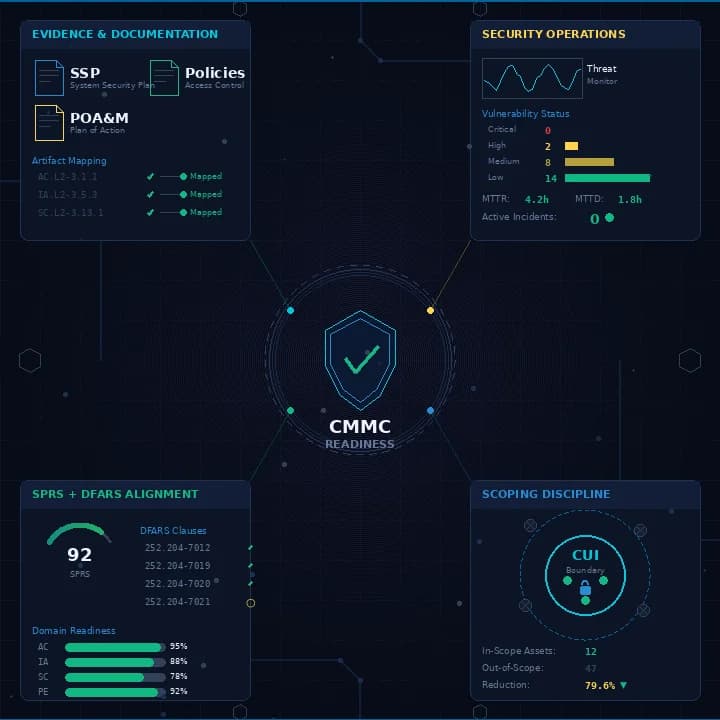
Your goal isn’t to “check boxes.” It’s to protect CUI, pass assessments, and keep compliance stable as your environment changes.
Understanding CMMC Levels & Requirements
CMMC 2.0 establishes three levels of cybersecurity standards. We guide you to the right level based on your contracts and the sensitivity of information you handle.
Basic cyber hygiene practices for Federal Contract Information (FCI). Required for all DoD contractors.
Key Requirements:
- Basic Access Control
- Identification & Authentication
- Media Protection
- Physical Protection
- System & Information Integrity
Ideal for: Small businesses handling FCI only
Assessment: Typically self-assessed
Comprehensive security for Controlled Unclassified Information (CUI). Aligns with NIST SP 800-171.
Key Requirements:
- All Level 1 requirements
- Security Assessments
- Incident Response
- Maintenance
- Risk Assessment
- Security Training
Ideal for: Companies handling CUI regularly
Assessment: Self or C3PAO assessment (contract-dependent)
Advanced/progressive cybersecurity to reduce APT risk. Requires additional practices beyond NIST 800-171.
Key Requirements:
- All Level 2 requirements
- Advanced Threat Hunting
- Managed Security Services
- Penetration Testing
- Security Operations Center
- Advanced Incident Response
Ideal for: Critical technology contractors
Assessment: Government-led assessment for critical programs
Our Three Pillars of CMMC Compliance
We streamline your path to certification by focusing on operations, documentation, and the security stack—then tying everything to evidence.
IT Processes
CMMC requires repeatable operations—not one-time checklists. We build and run processes that keep controls stable as your environment changes.
- •Access reviews, privileged access workflows, and change control
- •Incident response playbooks and tabletop exercises
- •Vulnerability management cadence with remediation tracking
Audit-Ready Documentation
Assessments succeed when evidence is mapped, current, and easy to trace. We produce the artifacts and keep them updated.
- •System Security Plan (SSP) aligned to NIST SP 800-171
- •POA&M tracking and evidence libraries per control family
- •Mock assessment prep and stakeholder interview rehearsal
Technology Stack
We help deploy and manage the security tooling commonly needed for CMMC programs—configured for evidence and retention.
- •MFA + identity hardening (Entra ID / Duo options)
- •Endpoint protection (EDR/XDR), encryption, and secure backups
- •SIEM visibility, logging retention, and alert triage workflows
Why Dallas DoD Contractors Choose ITECS for CMMC
As a Registered Provider Organization with certified professionals and a proven track record, ITECS delivers the expertise and support you need for successful CMMC certification.
Registered Provider Organization
ITECS is an authorized RPO with certified CMMC professionals on staff, ensuring expert guidance through your certification journey.
Dedicated CMMC Team
Our specialized team includes Certified CMMC Professionals (CCP) and Certified Assessors (CCA) with deep DoD contracting experience.
Proven Methodology
Our battle-tested CMMC implementation framework has helped 150+ contractors achieve certification on the first attempt.
Accelerated Timeline
We compress certification timelines by 40% through our streamlined processes and pre-built compliance templates.
Continuous Compliance
Beyond certification, we provide ongoing monitoring and management to maintain your compliance status year-round.
Industry Expertise
Deep experience across aerospace, defense manufacturing, engineering, and professional services sectors.
Your CMMC Journey: From Assessment to Certification
Our structured 5-phase approach ensures efficient implementation while minimizing business disruption.
Discovery & Assessment
1-2 weeks- Current security posture evaluation
- Gap analysis against CMMC requirements
- Risk assessment and prioritization
- Compliance roadmap development
Design & Planning
2-3 weeks- Security architecture design
- Policy and procedure development
- Technology stack planning
- Implementation timeline creation
Implementation
4-12 weeks- Security controls deployment
- System configuration and hardening
- Documentation creation
- Staff training and awareness
Validation & Testing
2-4 weeks- Control effectiveness testing
- Mock assessment preparation
- Remediation of findings
- Evidence package compilation
Certification & Beyond
Ongoing- C3PAO assessment coordination
- Audit support and guidance
- Continuous monitoring setup
- Annual compliance maintenance

Compliance is the outcome. Operational security is what keeps you compliant after the assessment.
The Outcome
Achieve CMMC compliance with confidence
Partnering with ITECS helps you build a defensible, evidence-backed compliance program that supports your contracts today and stays stable as your environment changes.
Accelerate readiness with scoping
Reduce in-scope systems by defining the CUI boundary and building a plan around evidence-first controls.
Reduce audit stress
SSP, POA&M, and artifacts are maintained as a living program—so you're not scrambling right before an assessment.
Strengthen security beyond compliance
Hardening, monitoring, and recovery planning reduce ransomware and credential-driven risk across your environment.
Compete for DoD work
CMMC readiness supports RFP requirements, prime contractor expectations, and ongoing contract eligibility.
What CMMC readiness looks like in the real world
No made-up company names. These are common engagement patterns we see across Dallas-Fort Worth defense contractors and subcontractors.
Aerospace supplier protecting CUI
Typical: 6–12 months
Focus areas
- Scope the CUI boundary and reduce in-scope systems
- Build SSP + POA&M evidence and remediation cadence
- Harden identity, endpoints, and logging for audit readiness
Engineering firm needing Level 1 fast
Typical: 30–90 days
Focus areas
- FCI scoping and baseline access controls
- Security awareness training and policy basics
- Artifact library to support customer and prime requests
DIB subcontractor modernizing Microsoft 365
Project-based
Focus areas
- Entra ID hardening, MFA, and conditional access
- Endpoint protection (EDR/XDR) and vulnerability management
- Logging + retention strategy with SIEM visibility
CMMC compliance packages by level
Start with the scope that matches your target level. Final pricing depends on CUI/FCI scoping, system complexity, and whether you need a dedicated CUI enclave or modernization work.
CMMC Level 1
Foundational Cyber Hygiene
- 17 CMMC practices implementation
- Policy and procedure templates
- Security awareness training
- Self-assessment preparation
- 90 days post-certification support
- Quarterly compliance reviews
CMMC Level 2
Advanced Security & CUI Protection
- 110 NIST 800-171 controls
- Complete SSP development
- POA&M management system
- Managed security tools
- 12 months continuous monitoring
- C3PAO assessment preparation
- Incident response planning
CMMC Level 3
Expert APT Protection
- All Level 2 requirements
- Advanced threat hunting
- 24/7 SOC monitoring
- Penetration testing
- Threat intelligence integration
- Dedicated compliance manager
- Executive reporting dashboard
Enterprise-Grade Tools for CMMC Compliance
ITECS deploys and manages the security stack commonly required for CMMC readiness—identity hardening, endpoint protection, logging, backup, and training—configured for evidence, retention, and audit traceability. We align tooling to your target level and scoping (including GCC High / Azure Government readiness when required).
Endpoint protection (EDR/XDR)
Threat detection and response for workstations and servers (Sophos and SentinelOne options)
Identity security + MFA
Entra ID hardening, phishing-resistant MFA, conditional access, and privileged access workflows
Logging + SIEM visibility
Centralized log collection, retention strategy, and alert triage (Microsoft Sentinel and SIEM options)
Backup + recovery testing
Encrypted backups, immutable storage options, and recovery drills (Veeam and equivalent platforms)
Security Awareness Training
KnowBe4 platform with phishing simulation and tracking

Beyond CMMC: DFARS + NIST 800-171 alignment
CMMC builds on DFARS obligations and NIST SP 800-171 requirements. We help you align controls, evidence, and reporting expectations—including incident reporting and SPRS scoring—so your compliance program supports contracts, assessments, and renewals.
DFARS 252.204-7012
Safeguarding CUI and reporting cyber incidents within required timeframes
DFARS 252.204-7019/7020
NIST 800-171 assessments and SPRS score reporting readiness
NIST SP 800-171
110 security requirements for protecting CUI in non-federal systems
NIST SP 800-172
Enhanced security requirements for critical programs and high-value assets
Why Dallas DoD contractors need a CMMC compliance partner
CMMC certification is no longer optional for organizations in the defense industrial base. The Department of Defense now requires contractors handling Controlled Unclassified Information (CUI) to demonstrate compliance at Level 1 or Level 2 before they can bid on contracts — and C3PAO assessors are evaluating not just policies on paper, but operational evidence that controls are implemented and maintained. For Dallas-area defense contractors, that means having a compliance partner who understands both the NIST 800-171 control framework and the practical IT infrastructure required to satisfy it.
ITECS delivers CMMC readiness from the same platform that powers our managed IT services and cybersecurity practice. That means the controls we implement — managed firewalls, endpoint detection and response, MFA enforcement, access logging, and backup and disaster recovery — aren’t bolt-on compliance theater. They’re production controls that protect your business every day and generate the evidence your assessor needs when certification time arrives.
CMMC Case Study

Defense manufacturer · 3 U.S. facilities
How ITECS Helped Senior Flexonics Pathway Achieve Full CMMC Compliance
Senior Flexonics Pathway, an ITAR-regulated manufacturer of precision expansion joints for defense and aerospace, engaged ITECS to build their complete CMMC compliance posture — from System Security Plan development and NIST 800-171 policy documentation to deploying dual high-availability firewalls across three facilities and standing up 24/7 managed security with EDR/MDR.
6
HA firewalls deployed
110
NIST controls addressed
24/7
NOC monitoring
Our Partners






CMMC Compliance FAQ
Straight answers to the most common questions we hear from Dallas-Fort Worth DoD contractors.
CMMC Next Steps & Support
Move your compliance program forward with current ITECS guidance, assessments, and advisor-led support for DoD contractors.
CMMC Readiness Assessment
Start with a structured review of your current controls, gaps, and certification readiness.
Start assessment →DFARS & NIST Alignment Review
Discuss SPRS scoring, incident reporting, and control alignment with an ITECS advisor.
Talk with an expert →CMMC FAQ Library
Review answers on assessments, evidence collection, timelines, and ongoing compliance support.
Review FAQs →Talk to a CMMC Specialist
Get help prioritizing remediation steps, evidence requirements, and assessor readiness.
Schedule a consultation →Ready to Secure Your DoD Contracts with CMMC Compliance?
Don't let CMMC requirements jeopardize your defense contracts. Partner with ITECS to achieve certification efficiently and maintain continuous compliance. Our experts are ready to guide you through every step of the journey.