
Managed Intelligence Provider (MIP): IT Support Evolved Beyond MSP and MSSP
ITECS is evolving beyond the MSP and MSSP models into a Managed Intelligence Provider (MIP) — operationalizing enterprise AI through localized agents, secure system integrations, and AI training, all on a governed managed-IT and cybersecurity foundation.
How ITECS keeps AI pilots controlled
Workflow first
We start with the manual work your team already understands before recommending any AI platform.
Budget controlled
Each pilot has a written scope, cost guardrails, owner, success criteria, and a clear stop/go decision.
Security built in
Access, data handling, vendor risk, and auditability are designed before any AI assistant touches business data.
Staff adoption
Training, feedback loops, and human approval paths keep the rollout useful instead of disruptive.
Clear definition
What Is a Managed Intelligence Provider (MIP)?
The MSP kept your systems running and the MSSP kept them secure. The Managed Intelligence Provider is the next step: the partner that integrates artificial intelligence into the systems and workflows your business already runs.
A Managed Intelligence Provider (MIP) is the next evolution beyond the MSP and MSSP. Alongside managing infrastructure and security, an MIP operationalizes enterprise AI — deploying localized AI agents, integrating internal CRMs and ERPs with large language models through secure APIs, and training teams to adopt AI safely and productively.
Managed IT foundation
Your infrastructure, identity, endpoints, cloud, and support model still need disciplined management.
See managed IT servicesManaged integration layer
Localized AI agents and system integrations are added on top of that foundation, only where they can safely improve a real workflow.
Explore AI consultingSnippet-first answer
AI should enter through a controlled workflow, not a surprise platform rollout.
The most successful SMB AI projects start small: one workflow, one owner, one data boundary, one measurable before-and-after. ITECS manages the technology, security, training, and ongoing tuning so adoption feels like an operational improvement rather than another tool your staff has to figure out alone.
The chasm
MSP vs. MSSP vs. MIP
Each model answers a different question. An MSP asks “is it running?” An MSSP asks “is it secure?” A Managed Intelligence Provider asks “is your business actually operationalizing AI?” The MIP does not replace the first two — it builds on them.
ITECS delivers all three layers — infrastructure, security, and AI integration — as one accountable partner.
Localized AI agents
Deploying Claude Code and Codex Safely
The most capable coding and workflow agents now run locally — on a developer’s machine or a controlled server — rather than as a distant cloud service. Run correctly, that is a security advantage. Run carelessly, it is an IP and compute risk. An MIP makes the difference.
Run agents where the work lives
We deploy coding and workflow agents like Claude Code and Codex directly on individual machines and controlled servers, so context stays close to the code, files, and systems being worked on.
Endpoint-scoped agent installs
Repository and file-system boundaries
No blanket network exposure
Protect source code and IP
Local execution means proprietary code and documents can stay on the endpoint instead of being uploaded to a public service — reinforced by permission scoping and audit logging of every agent action.
Least-privilege file access
Approved private model endpoints
Action logging and human approval gates
Manage compute and context
Autonomous agents can consume significant CPU, memory, and tokens. We right-size local context windows, set compute and cost guardrails, and tune concurrency so agents stay productive without degrading the machine.
Local context-window limits
Token and cost guardrails
Concurrency and resource caps
Bespoke AI architectures
System Integrations That Connect Your Business to AI
A generic chatbot cannot see your pipeline, your orders, or your tickets. Real value comes from connecting internal systems — your CRM, ERP, and line-of-business platforms — to large language models through secure, governed APIs, so AI acts on your real business data.
Connect internal systems to LLMs
We integrate the CRMs, ERPs, ticketing, and line-of-business systems your team already uses with large language models through secure, authenticated APIs — never copy-paste into consumer chatbots.
Authenticated REST / GraphQL APIs
Secure API gateway and secrets management
Scoped service accounts
Ground answers in your data
Retrieval-augmented architectures index approved documents and records as permission-aware vector embeddings, so agents answer from your real, current business data instead of guessing.
Vector embedding pipelines
Permission-aware retrieval
Citation-aware responses
Automate with event-driven webhooks
Bespoke agent architectures react to real business events — a new ticket, order, or record — through API webhooks, with human-in-the-loop approval on any sensitive or customer-impacting action.
API webhook orchestration
Human-in-the-loop approval
Exception routing and audit trails
The human component
AI Training & Adoption
Integration is only half the work. The other half is people. An MIP treats corporate AI training and change management as first-class deliverables, because the best architecture fails if employees don’t trust it, understand it, or use it safely.
Role-based AI training
Hands-on enablement tailored to each team — engineering, operations, sales, and leadership — so employees know when to use AI, when not to, and how to prompt it safely.
Safe-use guardrails
Clear policies on approved tools, data handling, and review requirements turn AI from a shadow-IT risk into a governed, sanctioned capability the whole company can trust.
Change management
Adoption is a people problem before it is a technology one. We manage the rollout, gather feedback, and iterate so new AI workflows actually stick instead of being quietly abandoned.
The real SMB hesitation
Why Dallas SMBs Pause Before Adopting AI
Most owners are not afraid of AI because they dislike innovation. They are hesitant because failed tool trials waste budget, employees resist unclear changes, and sensitive data can move into systems nobody has governed. Our first job is to make the rollout understandable, controlled, and safe enough to earn trust.
Unexpected cost creep
AI tools look inexpensive until seats, tokens, integrations, training, and abandoned trials stack up.
ITECS approach
We map the use case, compare build-versus-buy options, document expected operating costs, and pilot before a large rollout.
Operational disruption
Owners do not want a new platform that slows employees down or breaks proven workflows.
ITECS approach
We choose one contained workflow, run it alongside the existing process, and only expand after staff can trust the result.
Data leakage and compliance risk
Teams are unsure which files, prompts, customer records, or regulated data can safely touch AI systems.
ITECS approach
We define approved data sources, access rules, logging, retention expectations, and human review requirements before launch.
Tool confusion
Microsoft Copilot, ChatGPT, custom agents, CRMs, and automation platforms all sound useful but overlap quickly.
ITECS approach
We evaluate tools against your workflow, not vendor hype, so the recommendation fits your budget, stack, and risk tolerance.
Operational flow
From AI Curiosity to a Managed Pilot
ITECS.ai frames the common SMB problem clearly: teams know AI could help, but nobody knows where to start. On this ITECS service page, the answer is managed execution. We identify the workflow, define the guardrails, build the pilot, train users, and keep improving it after launch.
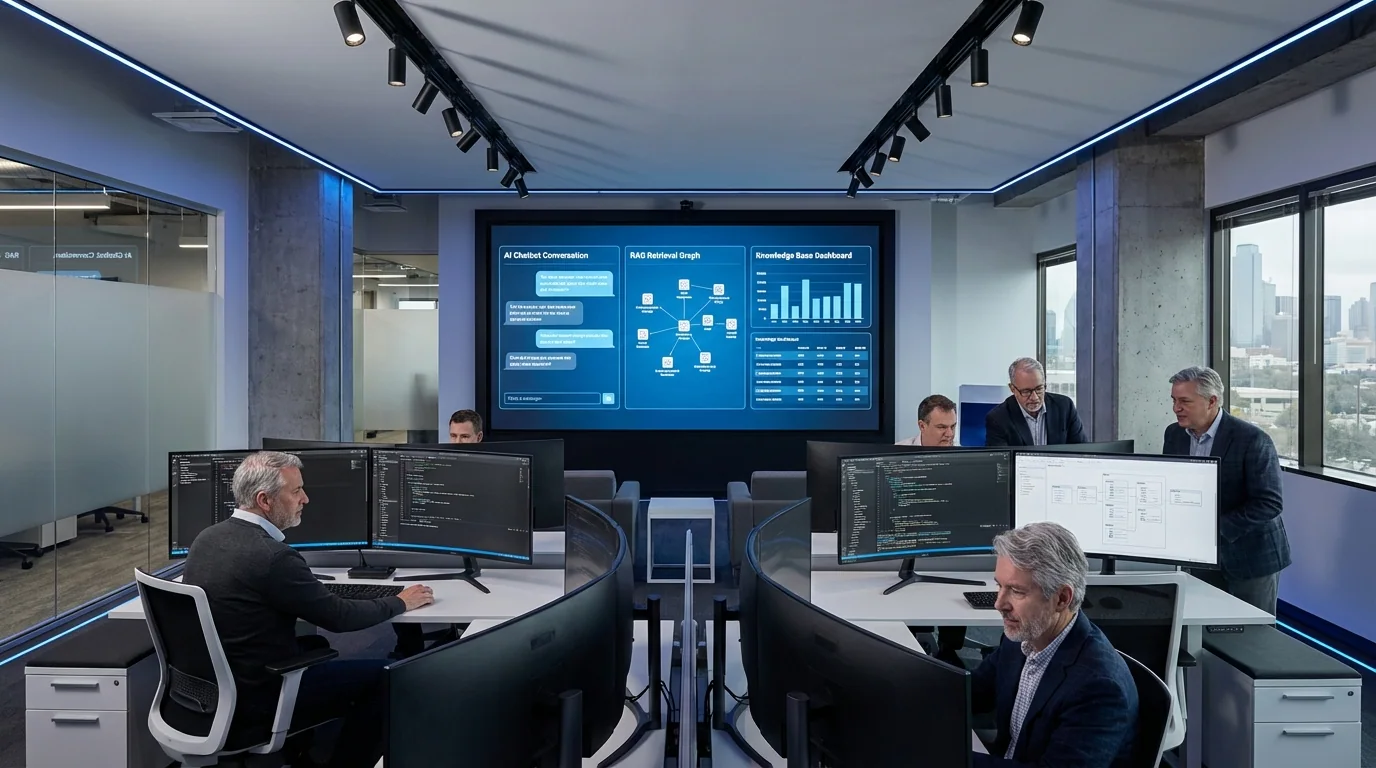
Practical AI delivery
Secure pilots before broad adoption
Find the safest first workflow
We interview stakeholders and identify repetitive, high-friction work where AI can help without creating unnecessary business risk.
- Workflow and data-source review
- Risk and compliance screening
- Owner and success criteria defined
Design the pilot and cost model
Before buildout, you see the proposed tools, integrations, permissions, training plan, support model, and expected ongoing costs.
- Vendor-neutral platform comparison
- Pilot scope and budget guardrails
- Human approval and fallback paths
Build, test, and train in phases
The pilot is tested with real users in a controlled scope so employees can trust the answers before AI touches broader workflows.
- Prompt and retrieval testing
- Employee training sessions
- Feedback loop and tuning backlog
Operate it like a managed service
After launch, ITECS monitors usage, updates knowledge sources, reviews exceptions, and keeps the AI system aligned with your business.
- Ongoing governance reviews
- Change management and retraining
- Security and performance monitoring
Practical sections SMBs expect
Where Managed Intelligence Usually Starts
SMB leaders want examples that sound like their actual business, not abstract promises. We focus on repeatable work with clear owners, clear boundaries, and clear escalation. These use cases can be piloted without replacing your core systems or asking your staff to learn an entirely new operating model overnight.
Support and customer intake
Guide customers, employees, or vendors to the right answer while preserving escalation paths for sensitive or complex requests.
Internal knowledge retrieval
Turn policies, SOPs, service docs, and playbooks into a controlled knowledge interface your team can actually use.
Document and reporting workflows
Summarize, classify, and route repetitive business documents without giving up human review or audit trails.
Sales, CRM, and admin follow-up
Reduce repetitive follow-up work in the systems your team already uses while keeping approvals in human hands.
Risk and cost controls
How We Keep AI Adoption From Becoming Expensive Chaos
A Managed Intelligence engagement should make AI easier to govern, not harder. ITECS connects the AI roadmap to your existing managed IT, cybersecurity, and cloud controls, using practical governance ideas aligned with the NIST AI Risk Management Framework: govern, map, measure, and manage before money is spent at scale.
Pilot gate
Prevents a broad rollout before the workflow proves useful.
Start with one department, one workflow, and documented acceptance criteria.
Data boundary
Keeps sensitive records out of unapproved tools and prompts.
Use approved repositories, permission-aware retrieval, and restricted admin access.
Human approval
Reduces business risk when AI drafts, classifies, or routes decisions.
Require review for financial, legal, HR, security, and customer-impacting actions.
Cost visibility
Stops surprise subscription, usage, or integration costs.
Document platform costs, integration work, support needs, and expansion triggers before launch.
AI build capabilities
Dallas AI Development Services for Production Outcomes
Once the pilot is defined, ITECS can design, code, secure, and operate custom AI systems that solve real operational bottlenecks. The goal is not a flashy demo. It is a reliable AI capability your employees can use, your managers can measure, and your IT leadership can govern.
AI Chatbot Engineering
Production chat assistants for websites, portals, and internal tools with secure context, intent routing, and escalation.
Persistent web chat UX
Intent-based navigation
CRM or ticketing handoff
RAG Agent Development
Retrieval-first agents connected to your approved documents and systems so responses stay grounded and auditable.
Vector ingestion pipelines
Chunking and ranking tuning
Citation-aware answer flows
Internal LLM Knowledge Hubs
Role-specific knowledgebases that help teams find SOPs, runbooks, and policy answers from approved sources.
Department-scoped access
Policy and SOP retrieval
Search plus conversational interface
Workflow and System Integrations
Automation across email, CRM, PSA, documentation, and line-of-business systems with approval and exception routing.
API and webhook orchestration
Back-office task automation
Human-in-the-loop controls
AI Security and Governance
Guardrails and controls that align AI rollout with security, compliance, data handling, and operational risk requirements.
Prompt and data guardrails
Audit logging and observability
Access controls
Managed AI Operations
Ongoing care for models, prompts, retrieval sources, integrations, and user feedback so the system improves responsibly.
Knowledge-source maintenance
Performance reviews
Roadmap and change control
Dedicated AI resource
Need Deeper AI Examples? Visit ITECS.ai.
This ITECS page explains how managed intelligence fits into your broader IT, security, and operations strategy. For deeper AI-specific guidance, examples, service lines, and plain-English adoption content, visit ITECS.ai — our dedicated site for practical AI consulting, automation, training, and custom agent development.
Explore ITECS.ai AI consultingAI consulting and readiness audits
Custom ChatGPT and AI agent development
AI automation for sales, support, and operations
Industry context
Managed Intelligence by Dallas Industry
AI adoption should respect the way each industry handles data, customers, deadlines, and compliance. ITECS brings the same practical approach to manufacturing, healthcare, legal, and financial-services teams: start with the workflow, define the guardrails, and expand only after the pilot proves operational value.
Manufacturing
- Maintenance knowledge search
- Quality documentation
- Vendor and inventory workflows
Healthcare
- Policy retrieval
- Intake support
- HIPAA-aware workflow review
Legal
- Matter intake summaries
- Document triage
- Internal knowledge search
Financial Services
- Client onboarding support
- Compliance documentation
- Report preparation workflows
Current Partner Credentials
MSSP Advanced

Gold Partner
Microsoft
Solutions Partner – Security
VCSP Silver

Technology Partner
Managed Intelligence Provider FAQ
An MSSP (Managed Security Service Provider) focuses on protecting your environment — threat detection, monitoring, and compliance. A Managed Intelligence Provider (MIP) is the next evolution: it keeps that security foundation but adds the work of operationalizing enterprise AI — deploying localized AI agents, integrating internal systems like CRMs and ERPs with large language models through secure APIs, and training staff to adopt AI safely. In short, an MSSP defends your systems while an MIP defends them and integrates intelligence into them.
Yes, when they are deployed with the right controls. Running agents such as Claude Code or Codex locally can actually reduce exposure because code and context can stay on the endpoint rather than being uploaded to a public service. ITECS governs this with scoped repository and file-system permissions, approved model endpoints (including private or enterprise API tiers with no training on your data), local context-window and compute limits, audit logging of agent actions, and human approval gates for sensitive operations — so the productivity of a local agent does not become an uncontrolled data or IP risk.
Prevention starts before any tool is chosen. An MIP defines approved data sources and model endpoints, routes traffic to enterprise or private LLM tiers that contractually exclude your data from training, and uses techniques such as on-premises or VPC-hosted models, retrieval over permission-aware vector embeddings, prompt and output filtering (DLP), and secure API gateways rather than copy-paste into consumer chatbots. Access is role-based and logged, and sensitive workflows require human review — so proprietary data and IP never silently flow into a public model.
A Managed Intelligence Provider designs, secures, deploys, and operates AI capabilities integrated into the systems and workflows a business already runs. Beyond the infrastructure of an MSP and the protection of an MSSP, an MIP deploys localized AI agents, connects internal CRMs and ERPs to large language models through secure APIs, and trains teams to adopt AI — turning artificial intelligence into governed, operational capability rather than isolated tools.
We start with one workflow and document the expected costs before rollout, including licenses, usage, integrations, staff training, support, and future expansion triggers. Custom builds are scoped only after requirements and data access are understood, so owners can make a clear stop/go decision.
The goal is to reduce repetitive work without forcing a sudden operating model change. We pilot AI in a contained workflow, keep human approval where judgment matters, train employees on safe use, and expand only after the team can trust the process and results.
Security starts before tool selection. ITECS defines approved data sources, role-based access, logging needs, retention expectations, vendor risk, and human review requirements. The final design is aligned to your security and compliance needs rather than assuming public AI tools are safe by default.
Good first pilots usually involve repeatable work with clear inputs and escalation paths: support intake, internal knowledge retrieval, document triage, report drafts, ticket enrichment, CRM notes, lead qualification, and administrative follow-up. We avoid high-risk workflows until controls are proven.
ITECS can operate the AI capability as a managed service. That includes usage monitoring, feedback review, prompt and retrieval tuning, knowledge-source maintenance, access updates, employee enablement, exception review, and roadmap planning for the next workflow when expansion is justified.
Visit https://itecs.ai for deeper AI-specific guidance from the ITECS AI team, including AI consulting, automation, training, data readiness, custom agents, and practical adoption content for Dallas SMBs.
Next step
Start With One Secure AI Pilot
If AI feels useful but risky, start with a practical workflow assessment. ITECS will help you choose a controlled pilot, understand the cost model, protect your data, and train your team before scaling.
Workflow Assessment
Identify the safest, highest-friction workflow to pilot first.
Schedule assessmentPilot Roadmap
Document tools, costs, training, security controls, and stop/go criteria.
Review AI consulting